

Recently updated on March 18th, 2026
Introducing algebra at an early stage helps children develop strong problem-solving and logical thinking skills. While algebra may sound like an advanced math topic, Grade 2 algebra is actually very simple and focuses on understanding patterns, relationships between numbers, and finding missing values in equations. Using engaging algebra worksheets for grade 2 allows students to practice these concepts in a fun and structured way.
When children work with simple algebra activities, they begin to see how numbers interact with each other. These early experiences build the foundation for more advanced math topics in later grades. According to the National Council of Teachers of Mathematics, introducing algebraic thinking in elementary school helps students develop reasoning skills and improves their overall mathematical understanding.
Below are some key types of worksheets that help Grade 2 students learn basic algebra concepts.
Table of Contents
ToggleWhat Is Algebra for Grade 2?
In Grade 2, algebra does not involve complicated formulas or variables like x and y. Instead, students focus on recognizing patterns and finding missing numbers in simple equations.
For example:
5 + ___ = 9
___ − 3 = 6
These types of problems encourage students to think about how numbers relate to each other. By solving these equations, children learn that math is not just about memorizing facts but also about understanding relationships between numbers.
Teachers and parents often introduce algebra concepts through games, puzzles, and worksheets that encourage exploration and critical thinking.
Missing Number Equations Worksheets
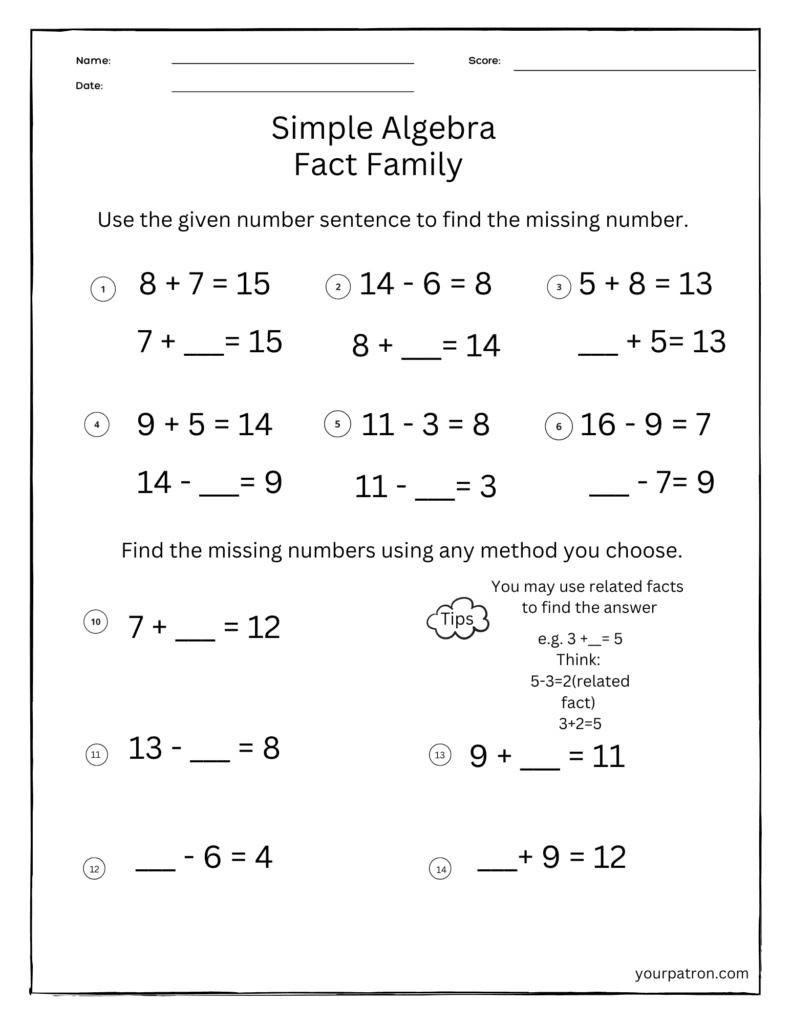
One of the most common ways to introduce algebra in Grade 2 is through missing number equations. These worksheets ask students to determine the number that makes an equation correct.
Examples include:
7 + ___ = 12
___ + 4 = 10
15 − ___ = 8
These exercises help students practice addition and subtraction while developing early algebra skills. Missing number worksheets also strengthen mental math and problem-solving abilities.
Balance Equations Worksheets
Balance equations help children understand that both sides of an equation must be equal. This concept builds the foundation for future algebra learning.
Example problems might include:
6 + 3 = ___ + 4
8 + 2 = 5 + ___
Students must determine the number that keeps the equation balanced. These worksheets encourage logical reasoning and help students visualize equations as balanced relationships between numbers.
Addition and Subtraction Algebra Worksheets
Addition and subtraction algebra worksheets combine basic arithmetic with simple algebraic thinking.
Activities may include:
Finding missing numbers in addition equations
Solving subtraction equations with blanks
Completing number sentences
For example:
___ + 6 = 13
14 − ___ = 9
These worksheets reinforce arithmetic skills while introducing the concept of solving for an unknown number.
Fact Family Worksheets
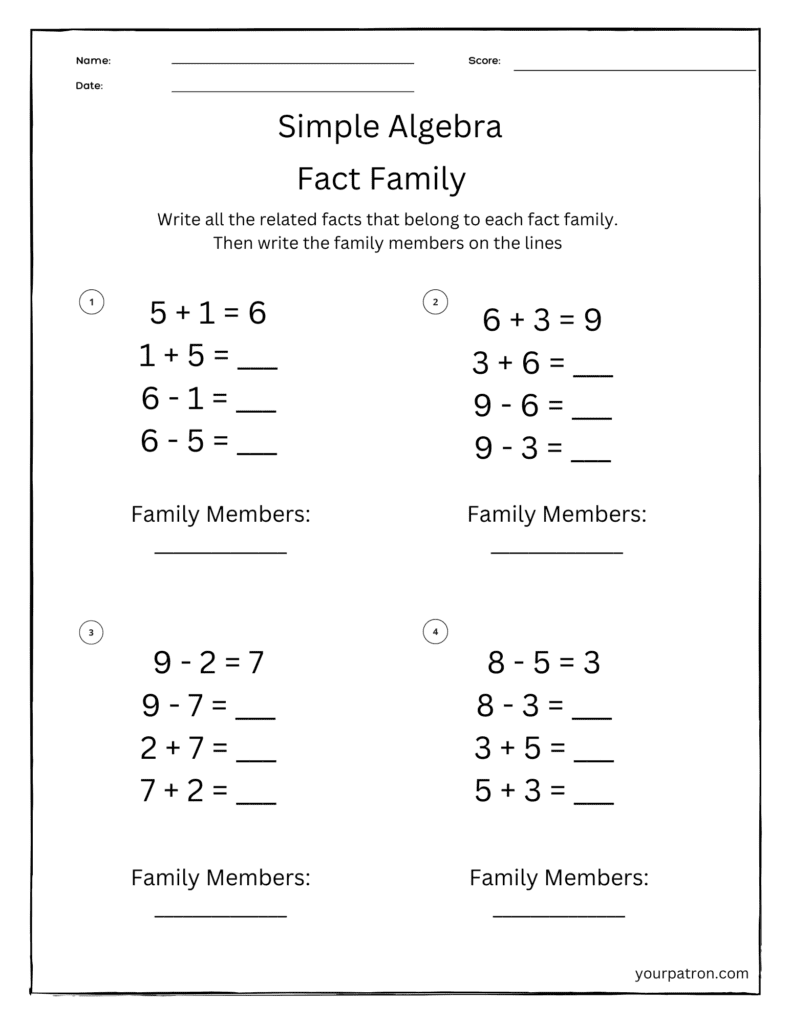
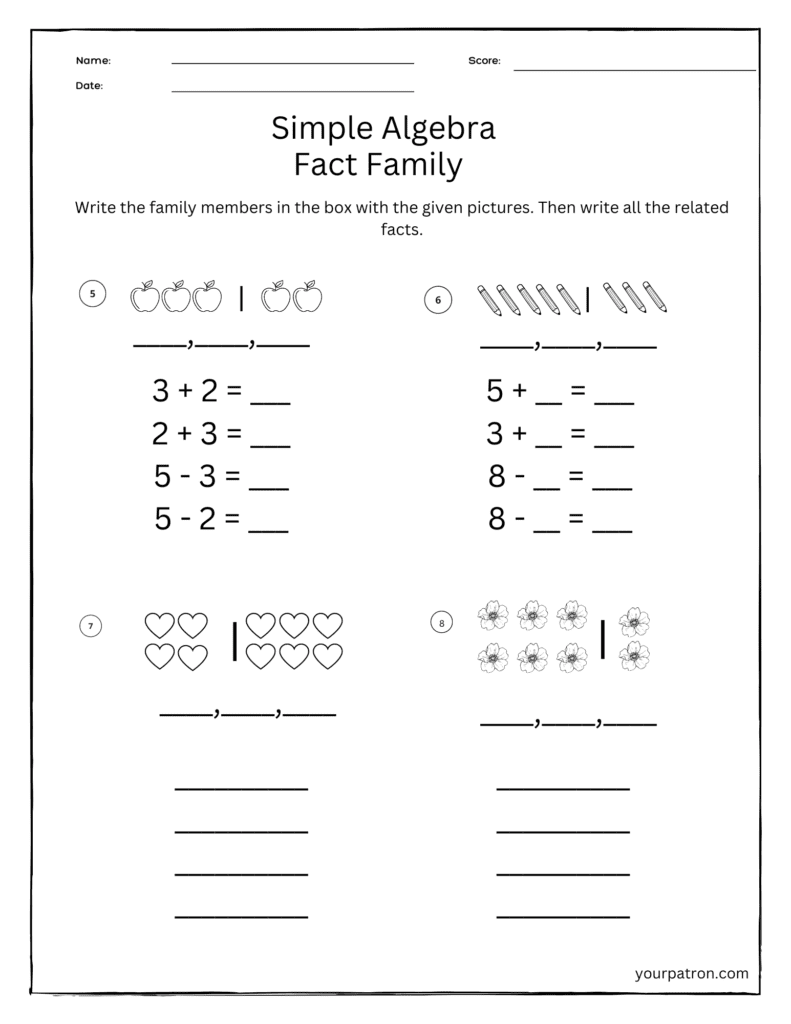
Fact families are an important part of early algebra learning in Grade 2. They help students understand the relationship between addition and subtraction using the same set of numbers.
A fact family usually includes three numbers that are connected through addition and subtraction.
Example:
For numbers 3, 5, and 8, the fact family is:
3 + 5 = 8
5 + 3 = 8
8 − 3 = 5
8 − 5 = 3
These relationships help students see how numbers are connected, which is a key concept in algebra.

Find the Unknown Number Worksheets
In these worksheets, students work with simple equations where one value is missing. The goal is to identify the unknown number that makes the equation true.
Examples include:
___ + 8 = 15
20 − ___ = 12
5 + ___ + 2 = 11
These exercises help children practice logical thinking and understand how numbers interact within equations.
Word Problems with Missing Numbers
Word problems are a great way to apply algebra concepts in real-life situations. They encourage students to read carefully, think critically, and determine the missing number based on the information given.
Example problems:
Emma had some apples. She bought 4 more and now has 10 apples. How many apples did she have at first?
Liam had 12 candies. He gave some to his friend and now has 7 left. How many candies did he give away?
These types of problems help students connect algebra with everyday situations, making math more meaningful and engaging.
Why Algebra Worksheets Are Helpful for Grade 2
Using algebra worksheets for grade 2 provides many benefits for young learners:
Develops logical thinking
Strengthens addition and subtraction skills
Builds confidence in problem solving
Prepares students for advanced math concepts
Since I create my own worksheets, each activity is designed to be simple, engaging, and suitable for young learners who are just beginning their journey into algebra.
Conclusion
Learning algebra in Grade 2 is all about exploring patterns, relationships, and missing numbers in simple equations. With well-designed algebra worksheets for grade 2, children can practice these foundational skills in a clear and enjoyable way.
Regular practice helps students build confidence in math and prepares them for more advanced algebra concepts in the future.